
- October 7, 2026
- 0 Comments
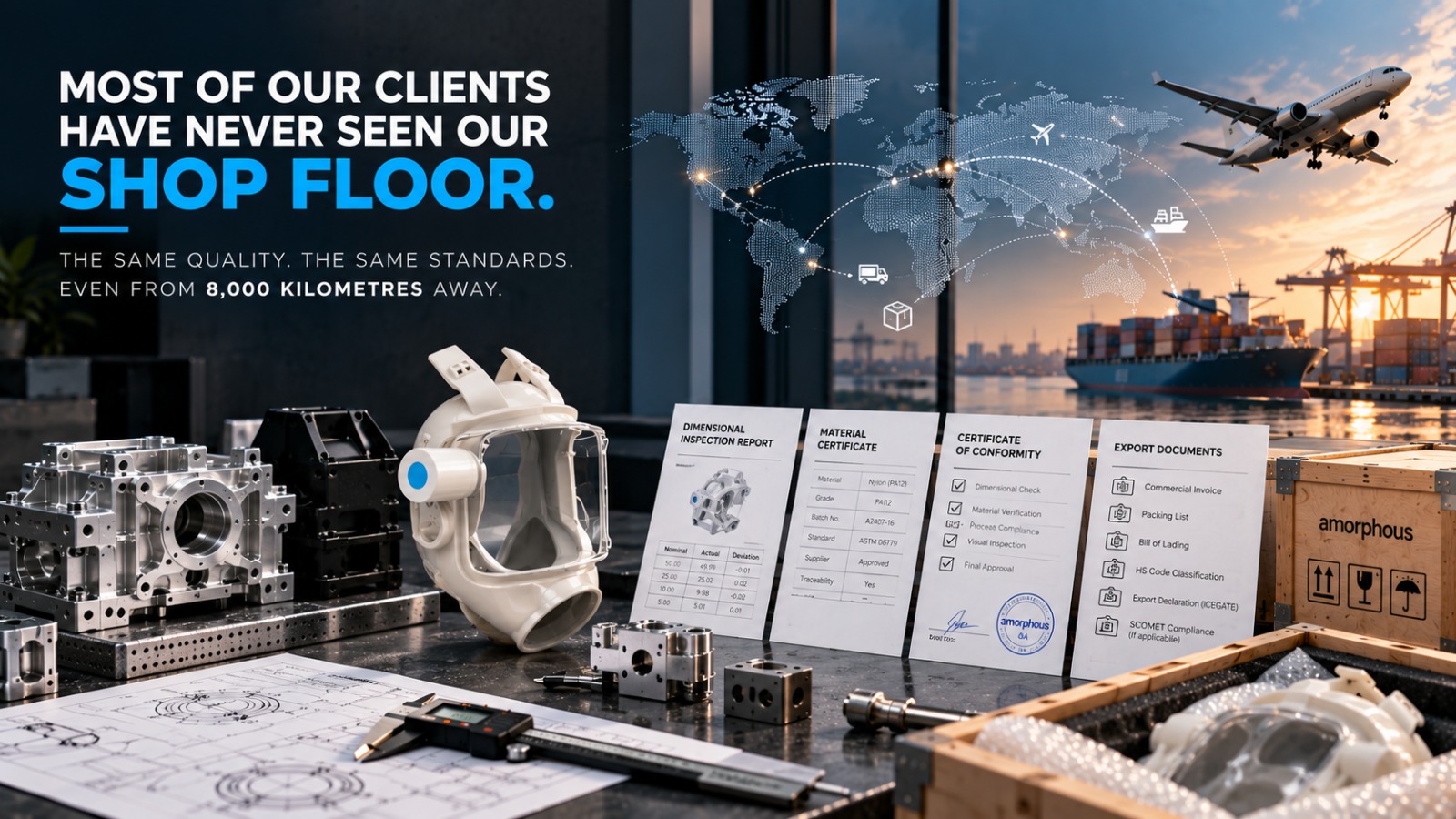
MOST OF OUR CLIENTS HAVE NEVER SEEN OUR SHOP FLOOR.
What quality control actually means when a client is 8,000 kilometres away, and the real import/export compliance work behind every part Amorphous ships out of India.
1. When a Handshake Isn’t an Option
Most of Amorphous‘s clients are international, and that changes the entire trust equation. A domestic client can walk the shop floor, hold a part before it ships, and settle a disagreement over a phone call the same afternoon. A client on another continent can’t do any of that — they’re trusting a report, a photo, and a set of measurements to stand in for everything they can’t see in person.
That’s why Amorphous treats documentation as seriously as the part itself. When the client can’t inspect the process, the GD&T-controlled tolerances has to do that job instead — which means it has to be complete, consistent, and built to a standard the client’s own quality team will actually recognize.
.
2. How Amorphous Prepares a Part for an International Client
Every export-bound order at Amorphous carries two parallel checklists — one for the part, one for the paperwork that lets it leave the country.
- Build the quality documentation package — Amorphous compiles dimensional inspection data, material certificates, and process records into a package built for the client’s industry — a medical client and an automotive client don’t expect the same paperwork.
- Classify the shipment correctly — Amorphous confirms the correct HS code and export classification for the part before it ships, since a misclassified shipment is one of the most common causes of a customs hold.
- Check for restricted or dual-use status — Amorphous screens anything UAV-related against India’s SCOMET dual-use control list before committing to a shipment date, since this is the one classification step that can genuinely stall a project if it’s caught late.
- Coordinate logistics and Incoterms — Amorphous agrees shipping terms with the client up front — who owns the part at each stage of transit — so responsibility for a shipping delay or a customs query is never ambiguous.
3. Quality Control: Proving It Without Them Seeing It
Amorphous has found that international clients ask sharper, more specific quality questions than local ones do — distance makes people more careful, not less.
Inspection data as the trust mechanism
A dimensional report, photos, and a certificate of conformance travel with every shipment. Amorphous treats this the same way our GD&T process treats any part — verified against the drawing, not assumed correct because the process usually works.
Meeting the standard the client’s industry expects
A medical device client, an aerospace client, and a consumer electronics client don’t all reference the same quality framework. Amorphous scopes documentation to match what’s actually being asked for — whether that’s a general quality management approach, an aerospace-specific standard, or a medical-device-specific one — rather than sending the same generic package to everyone.
Material traceability
International clients ask where the material actually came from far more often than domestic ones do. Amorphous keeps material certificates tied to specific batches, referenced against the Material Guide, so a traceability question can be answered with a document, not a guess.
4. Import/Export: The Part Nobody Mentions Until It Blocks a Shipment
Amorphous has learned that export compliance is invisible right up until it isn’t — a missing form doesn’t slow a project down gradually; it stops it cold at customs.
IEC and DGFT registration
An Import Export Code, issued by India’s Directorate General of Foreign Trade, is the basic identification number required to export anything out of India — without it, a shipment can’t clear customs or receive payment through a bank. Amorphous keeps this registration current, including the mandatory annual update DGFT requires between April and June.
HS codes and customs classification
Every exported part needs a correct Harmonized System code, filed through India’s customs electronic system at ICEGATE. Amorphous treats this as a technical step, not paperwork trivia — the wrong HS code can mean the wrong duty rate, or a shipment flagged for manual review that costs a week of transit time.
SCOMET and dual-use classification
This is the one that’s genuinely specific to Amorphous‘s UAV work. India’s SCOMET list — Special Chemicals, Organisms, Materials, Equipment and Technologies — controls dual-use items with civilian and military applications, and drones fall under Category 5B. DGFT simplified this in 2023 with a General Authorization for Export of Drones for many civilian-use cases, but the list itself was revised again in September 2025 with a new Category 7 covering emerging technologies, effective from October 23, 2025. Amorphous checks every UAV-related export against the current list before committing to a delivery date, because this classification changes more often than most exporters expect.
Incoterms and logistics ownership
Who’s responsible for a shipment at each leg of its journey is a negotiated term, not a default. Amorphous agrees this explicitly with every international client up front, so a customs delay or a damaged shipment has a clear owner instead of becoming a dispute.
5. The Friction Points That Actually Show Up
Amorphous has run into the same handful of recurring friction points working with an international client base — none of them are exotic, but all of them are avoidable with the right process.
- Time zone gaps delaying decisions: Amorphous structures design reviews and approvals so a client’s overnight response doesn’t stall a full production day.
- Documentation that doesn’t match a client’s internal format: Amorphous asks early what a client’s own quality or procurement system expects, rather than discovering a mismatch after a shipment is already in transit.
- Classification surprises on UAV-adjacent shipments: Amorphous treats SCOMET screening as a step in Design, not an afterthought bolted on right before a shipment date.
- A client who can’t verify anything in person: Amorphous leans on video walkthroughs, detailed inspection reports, and frequent updates during CNC and VMC machining or other production runs to close the gap a site visit would normally close.
6. Questions We Get From International Clients
-
Can you provide inspection documentation before shipment?
Yes — Amorphous sends dimensional reports and certificates of conformance ahead of or alongside every shipment, so a client can review the data before the part even arrives.
Do UAV components need special export clearance?
It depends on the specific component and its classification under SCOMET Category 5B. Amorphous checks this case by case before quoting a shipment timeline, since the list has been revised as recently as September 2025.
Who handles customs clearance on the receiving end?
That’s typically the client’s responsibility under standard Incoterms, though Amorphous coordinates closely on documentation to make that process as friction-free as possible.
How does Amorphous handle a customs delay once a part has shipped?
Amorphous stays involved past the shipment date — tracking, providing any additional documentation customs requests, and keeping the client updated, as part of our full Services engagement.
Sourcing from India and need it done right the first time?
Amorphous runs design, manufacturing, quality documentation, and export compliance as one connected process — not separate handoffs that leave gaps for a customs officer to find.
Talk to Amorphous — amorphousindia.com/contact
Further Reading