
- April 1, 2026
- 0 Comments
Using Digital Twins in CNC Machining and Laser Cutting: From Design to Real-World Output
Digital twins are quickly becoming the backbone of modern CNC and fabrication workflows, connecting CAD, CAM, machine data, and inspection into a single, live virtual model. For CNC shops and laser-cutting units like Amorphous India – Manufacturing & Design Services, this shift is not just “futuristic” jargon—it’s already saving time, reducing scrap, and improving consistency in production. By running a digital twin of each machining and cutting operation, we can validate geometry, nesting, and tool/laser-path behavior before a single gram of metal is removed.
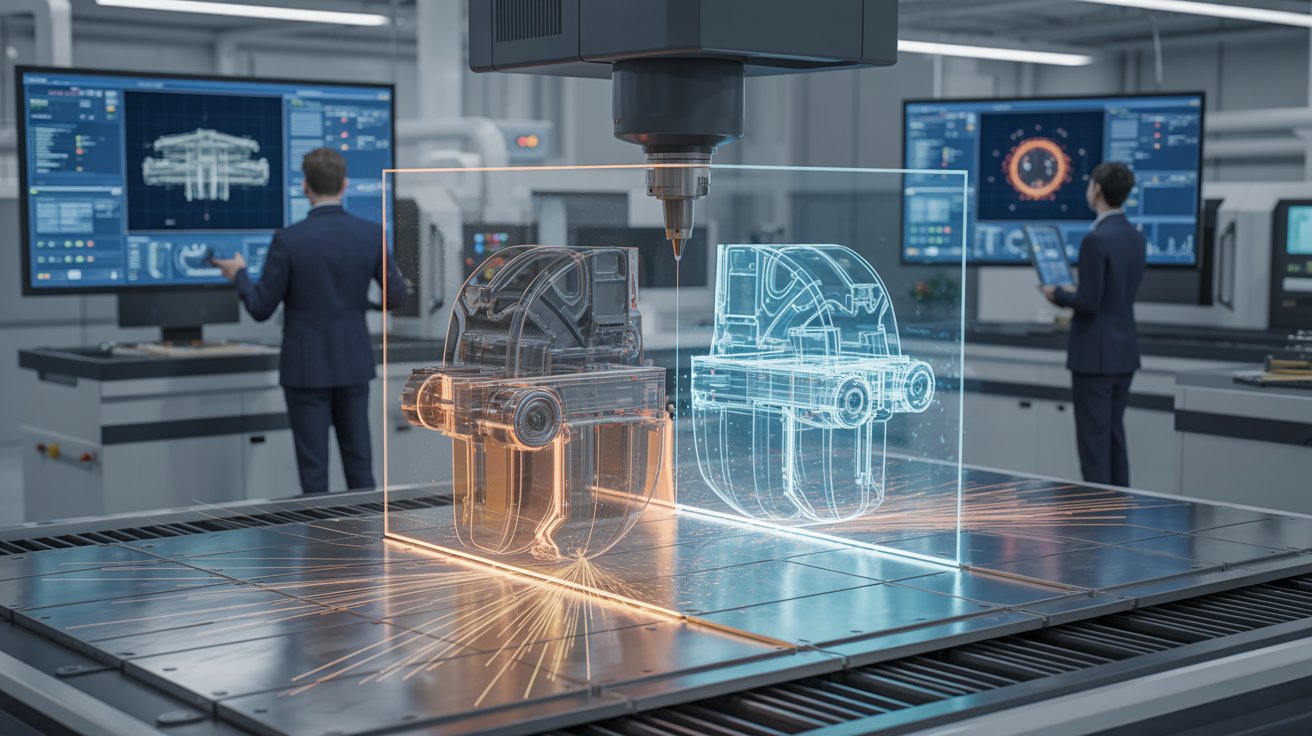
What Is a Digital Twin in CNC and Fabrication?
A digital twin for a CNC or laser-cutting workflow is a virtual replica of your entire production process: from the 3D CAD model through CAM programming to machine movements, speeds, and even inspection data. This live model mirrors what happens on the shop floor in real time, allowing engineers to simulate setups, detect collisions, optimize toolpaths, and foresee potential quality issues long before the first cut.
At Amorphous, we treat every critical CNC machining or fiber-laser cutting job as a small digital-twin system. We start with a precise CAD model, then simulate toolpaths, nesting, and laser trajectories in software, and only after the digital twin confirms a clean, optimized run do we send the job to the machine. This approach minimizes trial-and-error cutting and keeps material waste and rework to a minimum.
👉 Want to see how we simulate and optimize CNC and laser-cut parts before production? Explore our CNC machining and fabrication services here.
How Digital Twins Improve CNC Machining
In CNC machining, a digital twin helps prevent many of the most common costly mistakes: clashes between tools and fixtures, inefficient toolpaths, and over-cuts or under-cuts due to incorrect stock-model alignment.
At Amorphous, our workflow looks like this:
- CAD import and stock setup – the 3D model and stock block are imported into CAM and aligned exactly as they will be on the CNC machine.
- Toolpath simulation – the software simulates the full sequence of tool motions, speeds, and feeds, highlighting any areas where the tool might collide or overcut.
- Machine-specific validation – we simulate the CNC program on a virtual machine that matches our actual machine’s kinematics and limits.
Output to production – only when the digital twin shows a clean, collision-free, time-optimized run do we release the job to the shop floor.
This digital-twin-driven approach reduces programming errors, shortens setup time, and improves part-to-part consistency—especially important when producing brackets, housings, or custom fixtures for EVs, drones, and industrial systems. See examples of our CNC-machined parts in our portfolio.
Digital Twins in Fiber Laser Cutting and Nesting
For laser cutting, especially on sheet metal, the digital twin is equally powerful—nowhere more so than in nesting and kerf compensation. Fiber-laser systems cut with high precision, but if the CAD-to-laser path is not simulated correctly, you end up with over-cutting, poor edge quality, or inefficient nesting that wastes sheet metal.
At Amorphous, we use virtual models to:
- Optimize nesting – arrange multiple part profiles on the sheet so that material waste and remnant cuts are minimized.
- Validate cutting paths – check that the laser will follow the exact contours, avoid collisions with clamps, and maintain proper kerf width.
Estimate cutting time and cost – predict how long a job will take and how much gas, power, and consumables it will consume.
By running this digital twin of the laser-cutting process, we can deliver tighter tolerances, cleaner edges, and lower material cost per part—without risking damaged sheets or re-cutting. Discover how our laser-cutting and fabrication services combine precision and efficiency here.
Closing the Loop: Inspection, Feedback, and Continuous Improvement
A true digital twin doesn’t stop at machining or cutting; it also incorporates inspection data such as CMM measurements, optical scans, and first-article reports. This closed-loop flow lets Amorphous compare the as-built part back to the original CAD and CAM models, then update the process parameters if needed.
For example:
- If a machined pocket is slightly undersized, we adjust the toolpath offset in the digital twin and simulate the change before re-cutting.
- If a laser-cut feature is off by a few tenths due to kerf shift, we update the nesting model and re-simulate the layout.
Over time, this turns the digital twin into a “learning” system that continuously improves our CNC and fabrication workflows. View our precision-engineered parts and inspection-ready hardware in our portfolio.
Why Digital Twins Matter for CNC Shops in 2026
For Indian CNC shops and fabrication units aiming to serve global OEMs and deep-tech startups, digital twins are no longer a luxury—they are a competitive necessity. Clients expect:
- Lower scrap rates and predictable costs.
- Repeatable, documented processes that can scale.
- Faster turnaround from CAD to first good part.
At Amorphous India – Manufacturing & Design Services, we are already using digital-twin-style workflows to deliver high-precision CNC-machined and fiber-laser-cut parts that meet industrial and startup-grade requirements. If you’re building a drone frame, medical-device housing, or an industrial machine bracket, we can run a digital twin of your design through our machining and cutting pipeline before committing metal to the machine.
👉 Curious how a digital-twin-driven CNC and laser-cutting workflow can reduce your scrap and speed up production?
→ Contact Amorphous and request a digital-t