
- August 31, 2026
- 0 Comments
TWO METALS. ONE JOINT. VERY DIFFERENT RULES.
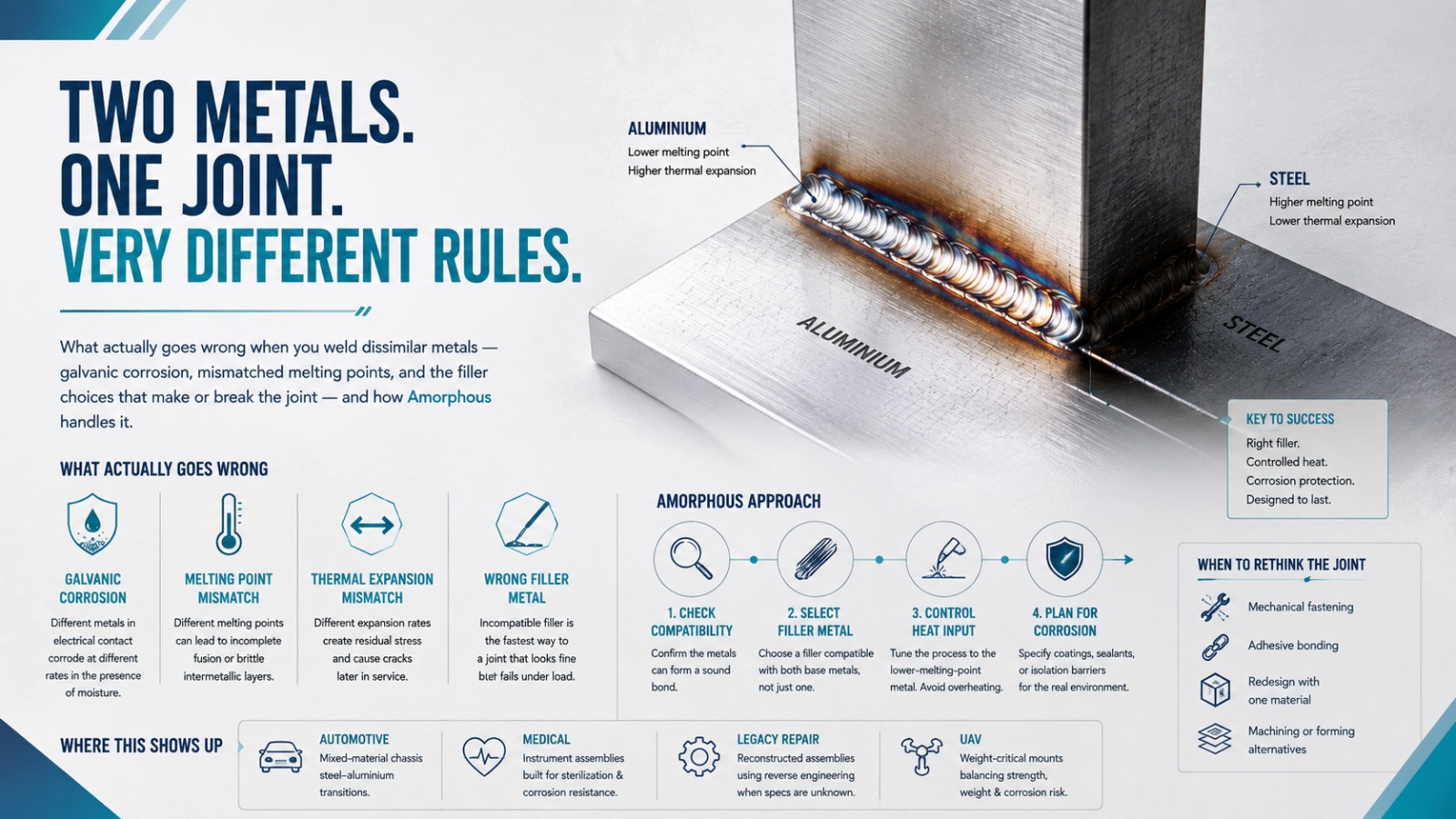
What actually goes wrong when you weld dissimilar metals — galvanic corrosion, mismatched melting points, and the filler choices that make or break the joint — and how Amorphous handles it.
1. Why Dissimilar Metals Break the Normal Rules
Welding two pieces of the same steel is a solved problem. Welding steel to aluminium, or stainless to mild steel, isn’t — the two metals don’t melt at the same temperature, don’t expand at the same rate, and don’t always want to bond at all. Amorphous treats dissimilar-metal joints through TIG and MIG welding as a materials problem first and a welding technique second, because the technique can’t fix a bad material pairing.
Most dissimilar-metal failures don’t show up at the weld itself, and they don’t show up immediately. Amorphous has seen joints pass a day-one inspection and then fail months later from corrosion or fatigue that only starts once the part is out in real-world humidity, vibration, and temperature swings — which is exactly why this decision gets made early, not patched after the fact.
.
2. How Amorphous Approaches a Dissimilar-Metal Joint
Every dissimilar-metal weld at Amorphous goes through the same checks before the torch is ever lit.
- Check metallurgical compatibility — Amorphous confirms the two metals can actually form a sound bond at all — some pairings, like aluminium and steel, resist true fusion welding almost entirely, referencing the Material Guide before committing to a joint design.
- Select the filler metal — Amorphous picks a filler that’s metallurgically compatible with both base metals, not just one of them — the wrong filler is the single most common cause of a dissimilar joint cracking during cooling.
- Control heat input — Amorphous tunes the weld process to the lower-melting-point metal, since overheating it before the other reaches fusion temperature is what turns a joint brittle.
- Plan for corrosion, not just strength — Amorphous specifies coatings, sealants, or isolation barriers at the joint wherever the metal pairing is prone to galvanic attack in the part’s actual service environment.
3. What Actually Goes Wrong
Amorphous sees the same handful of failure modes recur across dissimilar-metal projects — most of them are avoidable well before the weld itself.
Galvanic corrosion
Two different metals in electrical contact, with any moisture present, form a battery — and one of the metals corrodes faster than it would alone. Amorphous checks the galvanic series distance between the two metals before welding, since a steel-to-aluminium joint left uncoated near a coastal or humid environment can corrode within a single season.
Melting point mismatch and brittle intermetallic
When two metals with very different melting points fuse directly, the mixed zone can form brittle intermetallic compounds instead of a ductile bond. Amorphous avoids direct fusion on pairings prone to this — steel and aluminium being the classic case — and uses a compatible filler or transition piece instead.
Thermal expansion mismatch
Metals expand and contract at different rates as they heat and cool. Amorphous accounts for this residual stress at the design stage — through Simulation where the joint sees repeated thermal cycling — since it’s what causes a joint to crack weeks after welding, not during it.
Wrong filler metal
A filler chosen for one base metal alone, without checking compatibility against the other, is the fastest way to a joint that looks fine and fails under load. Amorphous cross-checks filler selection against both metals in the joint, every time, rather than defaulting to whichever filler is already loaded in the machine.
4. When to Weld Dissimilar Metals — and When Not To
Not every dissimilar-metal connection needs to be a weld. Amorphous reaches for mechanical fastening, adhesive bonding, or a redesigned single-material part through CNC and VMC machining or Sheet Metal Bending whenever the metal pairing is genuinely difficult to weld reliably — welding isn’t the only way to join two parts, just the most assumed one.
Where welding really is the right call — repairing a legacy assembly, joining structurally different materials for weight or cost reasons — Amorphous plans the joint at the Design stage with GD&T callouts that account for the joint’s real tolerance and fit needs, not the ones a same-metal weld would have used.
5. Where This Shows Up in Real Projects
Amorphous handles dissimilar-metal joints across a wide industry spread — browse the Projects gallery — and the failure risk that matters most changes by application.
- Automotive — Mixed-material chassis: Amorphous manages steel-to-aluminium transitions referenced against the Process Guide, where weight savings and structural strength both matter.
- Medical — Instrument assemblies: Amorphous selects corrosion-resistant filler and joint design checked against the Medical Guide for repeated sterilization cycles.
- Legacy repair — Reconstructed assemblies: Amorphous pairs this with reverse engineering when the original metal pairing on a part is unknown or undocumented.
- UAV — Weight-critical mounts: Amorphous evaluates whether a lighter dissimilar-metal joint is worth the added corrosion risk versus a heavier single-material alternative.
7. Questions We Get from Clients
Can any two metals be welded together?
No — some pairings, like aluminium and steel, resist reliable direct fusion. Amorphous checks compatibility first and recommends an alternative joining method when direct welding isn’t a sound option.
How do you prevent galvanic corrosion after welding?
Coatings, sealants, and physical isolation from moisture at the joint are the main defences. Amorphous specifies these based on the part’s actual service environment, not a generic default.
Does a dissimilar-metal joint need special inspection?
Often yes — visual inspection alone can miss brittle intermetallic formation. Amorphous checks joint quality against the design intent before a part ships.
Is it cheaper to redesign around one material instead?
Sometimes — it depends on weight, cost, and performance trade-offs. Amorphous weighs this option as part of our full Services engagement rather than assuming a weld is always the right answer.
Joining two different metals and want it to actually hold?
Amorphous runs welding alongside design, simulation, and production — one team, one model, no handoffs.