
- August 4, 2026
- 0 Comments
EVERY STRUCTURE FAILS ON PAPER FIRST
A working engineer’s guide to Finite Element Analysis — how it works, where it earns its keep, and why Amorphous runs it before anything reaches a machine
1. What FEA Actually Is
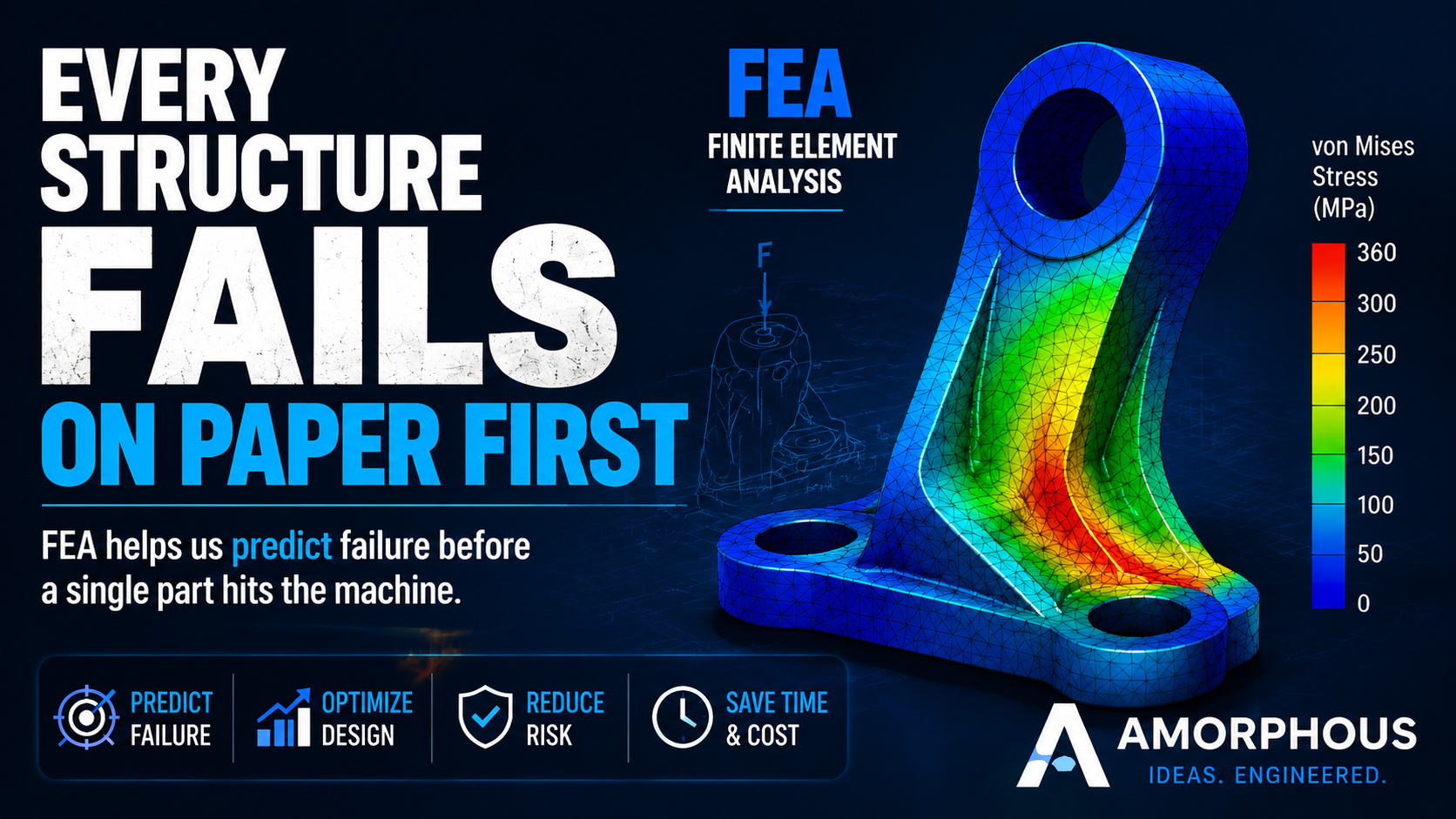
Finite Element Analysis breaks a real part — a bracket, a housing, a wing rib — into thousands of small, simple pieces the computer can solve one at a time. Amorphous uses this every day, as part of our Simulation service, to answer a question no hand calculation can: what happens to this exact shape, under this exact load, right up to the point it doesn’t hold. It’s less “prediction” and more “controlled failure,” rehearsed safely before the part exists.
The math underneath is decades old — it comes out of structural engineering and aerospace work from the 1950s and 60s — but the reason it matters at Amorphous today is speed. A design that once needed a physical prototype to validate can now be loaded, stressed, and broken virtually in an afternoon, and the fix goes back into CAD the same day. (Read the underlying method)
.
2. How Amorphous Runs a Simulation
Every FEA study at Amorphous follows the same four moves, whether it’s a UAV arm or a medical device housing. Skip a step and the answer is just a confident-looking wrong number — so the sequence below isn’t optional.
- Idealize the geometry — Amorphous simplifies the CAD model — a step that starts in our Design service — removing fillets and features that don’t affect the physics, so the solver spends its budget where the load actually lives.
- Mesh it — the part is divided into elements — tetrahedra, hexahedra, or shells — inside our Simulation workflow. Amorphous tunes density by region: coarse where nothing’s happening, fine at fillets, holes, and joints.
- Apply loads and constraints — Amorphous defines how the part is actually held and loaded in service — a press fit, a bolt pattern, a drop — because a wrong boundary condition invalidates everything downstream.
- Solve and read the result — the solver returns stress, deflection, and factor of safety. Amorphous checks this against test data or hand calcs before it’s allowed to inform a design decision.
3. Not All FEA Answers the Same Question
Amorphous picks the analysis type to match the failure mode we’re actually worried about — running the wrong one is a common way teams waste simulation budget.
Structural / Static
The default starting point: fixed loads on a fixed geometry. Amorphous uses static structural FEA, tied directly into our Design service, to size wall thickness, ribs, and bolt bosses on nearly every enclosure and bracket project — it’s the fastest way to catch an under-built part before it’s cut on the CNC.
Thermal
Heat doesn’t care about your load case. When a housing sits next to a motor or a battery pack, Amorphous runs thermal FEA through our Simulation service to map temperature gradients and thermal expansion, since a part that’s structurally fine at 25°C can warp or crack at 80°C.
Modal / Vibration
Anything that spins, vibrates, or flies needs this. Amorphous runs modal analysis, often alongside our Topology Optimization and Generative Design service, to find natural frequencies early — because a UAV arm or drone frame that resonates with its own motor is a field failure waiting to happen, one a static-only study would never catch.
Fatigue
Most real parts don’t fail from one big load — they fail from thousands of small ones. Amorphous applies fatigue analysis on parts that see repeated cycling — landing gear, consumer product hinges bound for our Plastic Injection Molding service — to estimate life in cycles, not just whether it survives load number one.
4. Where This Shows Up in Real Projects
Amorphous runs FEA across a genuinely wide spread of industries — browse the Projects gallery — and the questions change every time, even when the solver stays the same.
- UAV — Airframes & arms: Amorphous checks vibration and impact tolerance, often after a Topology Optimization pass, before a single carbon layup is cut.
- Automotive — Brackets & mounts: Amorphous validates fatigue life against road-load cycles referenced in our Process Guide, not just peak stress.
- Medical — Device housings: Amorphous simulates drop and sterilization thermal cycles, cross-checked against our Medical Guide, for compliance-ready designs.
- Consumer — Enclosures & hinges: Amorphous tunes wall thickness for injection molding using our Material Guide without over-engineering material cost.
5. Why Simulate Before You Prototype
A physical prototype answers one question at a time, at real cost and real lead time. Amorphous treats FEA as the cheap iteration loop that happens before Digital Prototyping and physical builds — a dozen virtual design variants can be tested in the time it takes to machine a single physical part. That’s not a replacement for prototyping; it’s what makes the eventual prototype worth building.
The payoff compounds on anything going into production. Amorphous has used simulation to catch stress concentrations at fillets, resonance issues in rotating assemblies, and thermal warping in enclosures — all before CNC & VMC Machining tooling was committed, when a fix is a CAD edit rather than a re-cut mold. (NAFEMS: what is CAE/FEA)
6. Questions We Get From Clients
Does a finer mesh always give a better answer?
Up to a point. Amorphous refines mesh, within our Simulation service, until the result stops changing significantly between iterations — that’s mesh convergence. Past that point, extra elements just add solve time without adding accuracy.
Can FEA fully replace physical testing?
No — Amorphous uses it to narrow down which physical tests are actually worth running, and to explain a failure once it happens. Regulatory and safety-critical parts still need physical validation.
How early in a project should simulation start?
As early as there’s a rough CAD model. Amorphous prefers running a first-pass FEA before a design is “finished,” since that’s when changes are still cheap.
What software does Amorphous use?
The tool is matched to the job — from CAD-integrated solvers for quick checks to dedicated packages for detailed structural, thermal, and fatigue work, spanning our full Services list — with results always sanity-checked against hand calculations.
Have a part that needs to survive something?
Amorphous runs FEA alongside CAD, prototyping, and production — one team, one model, no handoffs.
Talk to Amorphous — amorphousindia.com/contact