
- August 31, 2026
- 0 Comments
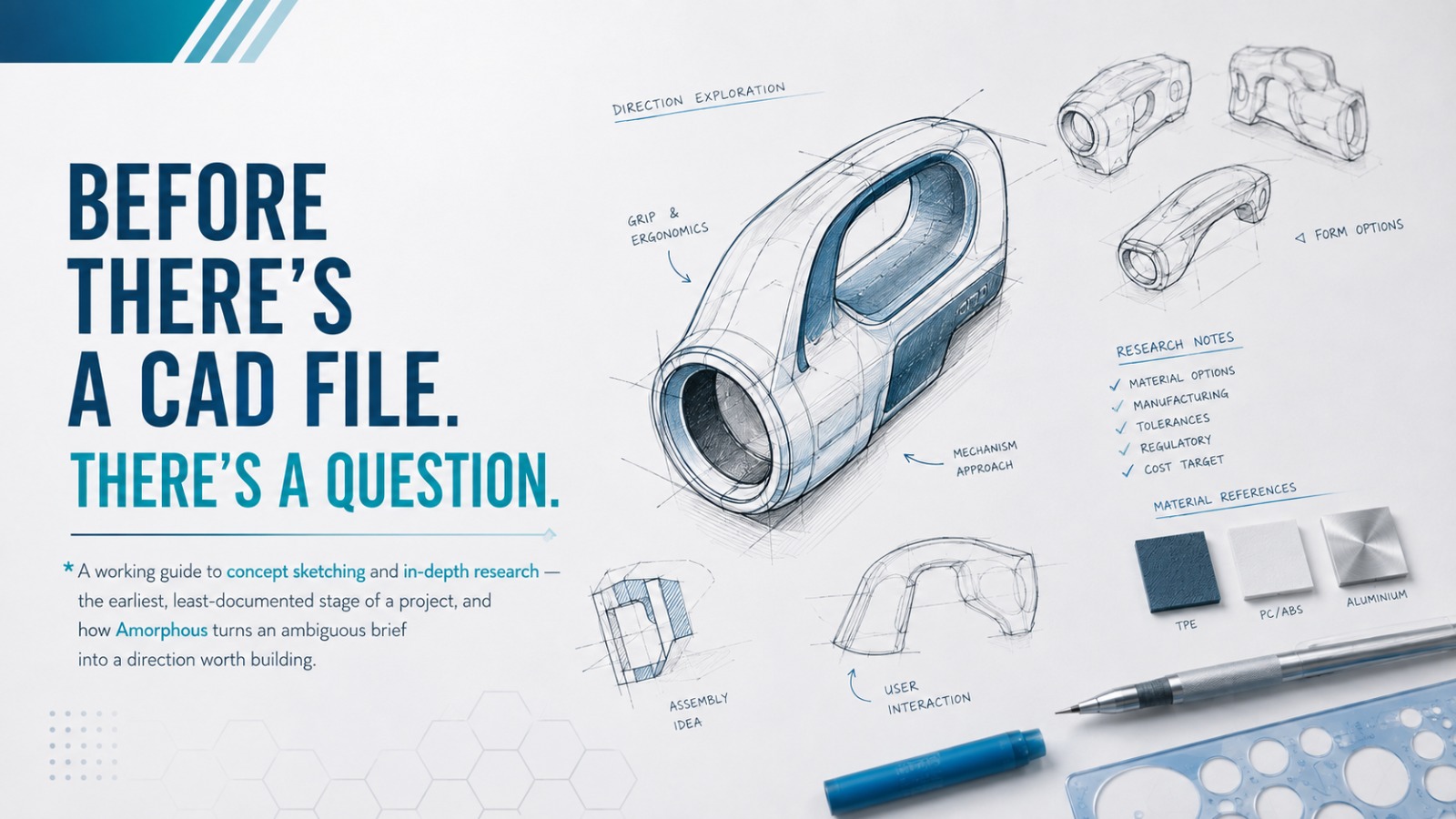
BEFORE THERE’S A CAD FILE, THERE’S A QUESTION..
A working guide to concept sketching and in-depth research — the earliest, least-documented stage of a project, and how Amorphous turns an ambiguous brief into a direction worth building.
1. The Stage Before Anyone Opens CAD
Most engineering content starts with a CAD model already open. The stage before that — where a brief is still vague, the market isn’t mapped, and nobody’s sure what the part should even look like — rarely gets talked about, even though it decides more than any single design review later on. Amorphous treats concept sketching and in-depth research as this stage’s two tools, used together before a single surface gets modelled.
Skipping straight to CAD from an ambiguous brief doesn’t save time — it just moves the ambiguity downstream, where fixing it costs a redesign instead of a redraft. Amorphous front-loads that uncertainty here, on purpose, because a wrong direction is cheap to abandon as a sketch and expensive to abandon as a finished model.
.
2. How Amorphous Turns a Brief into a Direction
Every ambiguous brief at Amorphous moves through the same arc before it’s allowed to become a CAD file.
- Ask what’s actually unknown — Amorphous separates real constraints — budget, regulation, timeline — from assumptions nobody’s actually tested, since those two get treated very differently from here on.
- Research the unknowns — Amorphous runs in-depth research into materials, manufacturability, competitor products, and regulatory requirements, so decisions later are based on evidence instead of assumption.
- Sketch multiple directions, fast — Amorphous produces several rough concept sketches in parallel rather than one polished idea, because the point here is coverage of the option space, not commitment to any single one.
- Narrow and hand off — Amorphous scores the surviving directions against the research findings, then only the chosen concept moves into Design as an actual CAD model.
3. Two Different Jobs, One Early Stage
Amorphous keeps research and sketching as distinct activities — mixing them up early tends to produce sketches that look decisive but are built on nothing.
In-depth research: answering what’s actually unknown
This is the unglamorous half — market landscape, material properties, manufacturing constraints, regulatory requirements. Amorphous treats in-depth research as the guardrail that keeps the sketching phase from wandering into directions that were never viable to begin with.
Concept sketching: visualizing what’s actually possible
Sketching moves faster than CAD and costs nothing to throw away. Amorphous uses concept sketches to explore form, layout, and mechanism options a client can react to immediately — often surfacing a preference nobody could have articulated from a spec sheet alone.
Where they meet
Neither one works well alone. Amorphous checks every sketched direction against the research findings before it’s allowed to survive to the next round — a beautiful concept that ignores a known manufacturing constraint is just a more expensive way to arrive at the same dead end.
4. Where This Shows Up in Real Projects
Amorphous runs this stage across a wide industry spread — browse the Projects gallery — and what the research needs to answer changes by industry even when the sketching process doesn’t.
- Medical — Device concepts: Amorphous researches regulatory and sterilization requirements against the Medical Guide before a single form-factor sketch is drawn.
- Automotive — Legacy part replacements: Amorphous pairs early sketching with reverse engineering when the starting point is an existing part rather than a blank page.
- Consumer — New product concepts: Amorphous researches material options via the Material Guide while sketching multiple form directions for early client feedback.
- UAV — Airframe layout: Amorphous sketches arm and frame layout options early, then hands the chosen direction to Topology Optimization once the concept is locked.
5. Why This Stage Is Worth the Time It Takes
A client under deadline pressure often wants to skip straight to a rendered model — it feels like progress. Amorphous pushes back on that instinct, because a polished rendering of the wrong concept is a worse outcome than a rough sketch of the right one — it just takes longer to find out it was wrong.
The payoff shows up later, not here. Amorphous has watched projects with a thin research phase resurface the exact same open questions during Simulation or Digital Prototyping — except now they’re blocking a deadline instead of a sketch.
6. Questions We Get from Clients
How long does research and concept sketching actually take?
It scales with how ambiguous the brief is. Amorphous scopes this per project rather than quoting a flat timeline, since a well-defined brief needs far less of it than an open-ended one.
Do I need to know exactly what I want before coming to Amorphous?
No — this stage exists specifically for briefs that aren’t fully defined yet. Amorphous is often brought in precisely because the direction isn’t clear.
How many concept directions does Amorphous typically explore?
It varies by project, but Amorphous deliberately sketches more than one so a client is choosing between real options, not approving the only one that exists.
What happens if research reveals the original brief isn’t feasible?
That’s exactly what this stage is for — catching it here. Amorphous brings findings back to the client early, spanning our full Services engagement, so the brief can adjust before real cost is committed.
Have a bried that isn’t fully defined yet?
Amorphous runs research and concept sketching alongside design, simulation, and production — one team, one model, no handoffs.
Talk to Amorphous — amorphousindia.com/contact