
- March 3, 2026
- 0 Comments
Design for Manufacturing (DFM): How Smart Design Decisions Reduce Cost and Improve Quality
Introduction
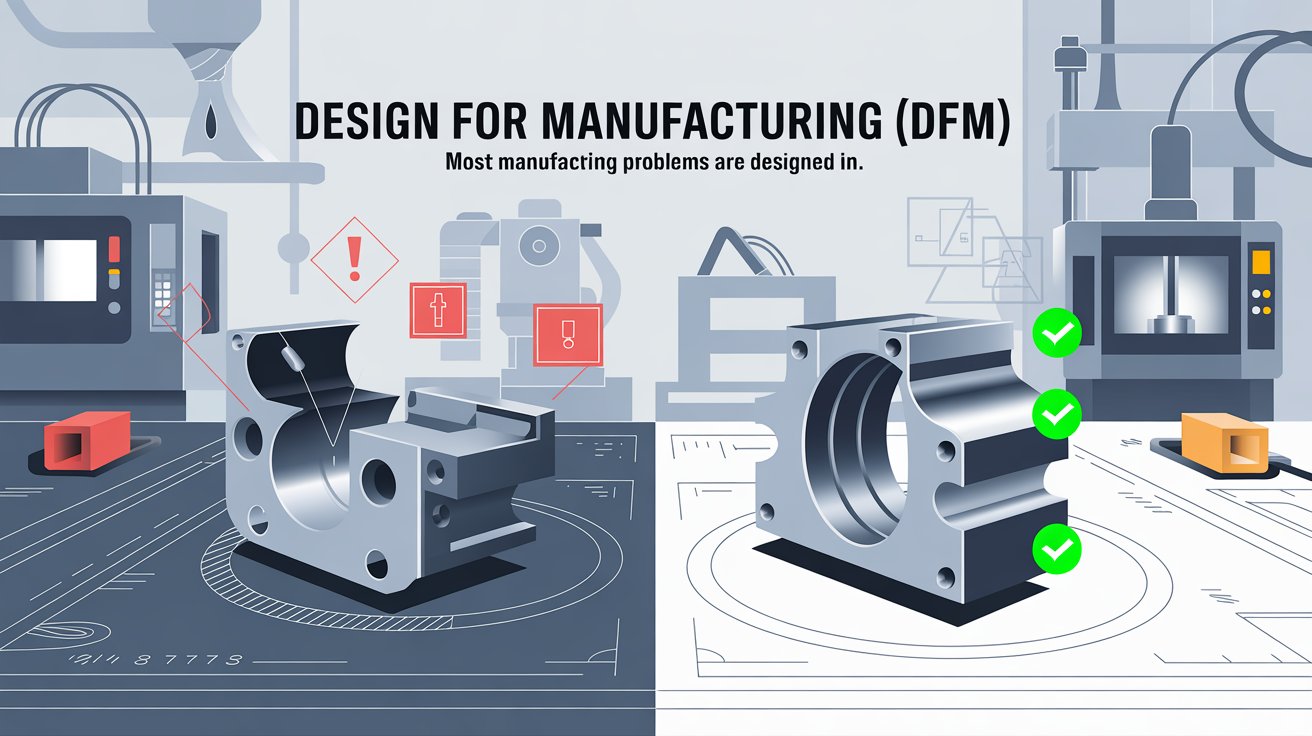
In modern product development, manufacturing challenges rarely begin on the shop floor. Most of them originate much earlier—during the design phase. Design for Manufacturing (DFM) is a systematic approach that ensures products are designed in a way that simplifies manufacturing, reduces cost, and improves reliability.
At Amorphous India, DFM is integrated into every stage of product development—from initial CAD modeling to final production. By aligning design intent with manufacturing capabilities early, companies can avoid costly redesigns, delays, and inefficiencies.
What is Design for Manufacturing (DFM)?
Design for Manufacturing (DFM) is the process of designing products in a way that makes them easy, cost-effective, and reliable to manufacture.
Rather than asking:
“Can this be manufactured?”
DFM asks:
“Can this be manufactured efficiently, consistently, and at scale?”
At Amorphous India, DFM involves evaluating geometry, materials, tolerances, and processes to ensure optimal manufacturability.
🔗 Explore design services: https://amorphousindia.com/services/design
🔗 Get a manufacturability review: https://amorphousindia.com/contact
Why DFM Matters in Product Development
Ignoring DFM leads to:
-
Increased manufacturing costs
-
Longer production times
-
Higher rejection rates
-
Assembly issues
-
Tooling complications
At Amorphous India, early DFM implementation helps eliminate these risks, ensuring smoother transitions from design to production.
Key DFM Principles
1. Simplify Geometry
Complex parts are expensive to manufacture.
Reducing unnecessary features:
-
Lowers machining time
-
Reduces tooling complexity
-
Improves repeatability
At Amorphous India, simplification is achieved without compromising performance.
2. Optimize Tolerances
Tighter tolerances increase cost.
Every micron of precision requires:
-
More machining time
-
Better tools
-
Strict inspection
At Amorphous India, tolerances are defined based on functional requirements, not assumptions.
3. Select the Right Manufacturing Process
Each process has limitations.
For example:
-
CNC machining struggles with sharp internal corners
-
Injection molding requires draft angles
-
3D printing has anisotropic strength
At Amorphous India, process selection is aligned with design from the beginning.
🔗 CNC machining: https://amorphousindia.com/services/cnc-machining
🔗 3D printing: https://amorphousindia.com/services/3d-printing
4. Material Selection Matters
Choosing the wrong material can increase cost or reduce performance.
Consider:
-
Strength requirements
-
Heat resistance
-
Machinability
-
Cost
At Amorphous India, material selection is optimized for both performance and manufacturability.
5. Design for Assembly (DFA)
Reducing part count improves efficiency.
Benefits include:
-
Faster assembly
-
Lower labor cost
-
Reduced error
At Amorphous India, DFM and DFA are applied together for optimal results.
Common DFM Mistakes
❌ Over-engineering
❌ Ignoring process limitations
❌ Late-stage design changes
❌ Poor tolerance management
These issues are frequently identified and resolved at Amorphous India during early design reviews.
How DFM Reduces Cost
DFM reduces cost by:
-
Minimizing material waste
-
Reducing machining time
-
Lowering tooling complexity
-
Avoiding redesign cycles
At Amorphous India, cost reduction is achieved without compromising quality.
Applications Across Industries
DFM is critical in:
-
Automotive
-
Consumer electronics
-
Medical devices
-
Industrial equipment
At Amorphous India, DFM ensures products meet industry standards and performance expectations.
Conclusion
Design for Manufacturing is not just a design approach—it is a strategic advantage.
At Amorphous India, integrating DFM early ensures efficient production, lower costs, and high-quality outcomes.
Looking to optimize your product for manufacturing?
🔗 Get expert support from Amorphous India: https://amorphousindia.com/contact