
- October 27, 2026
- 0 Comments
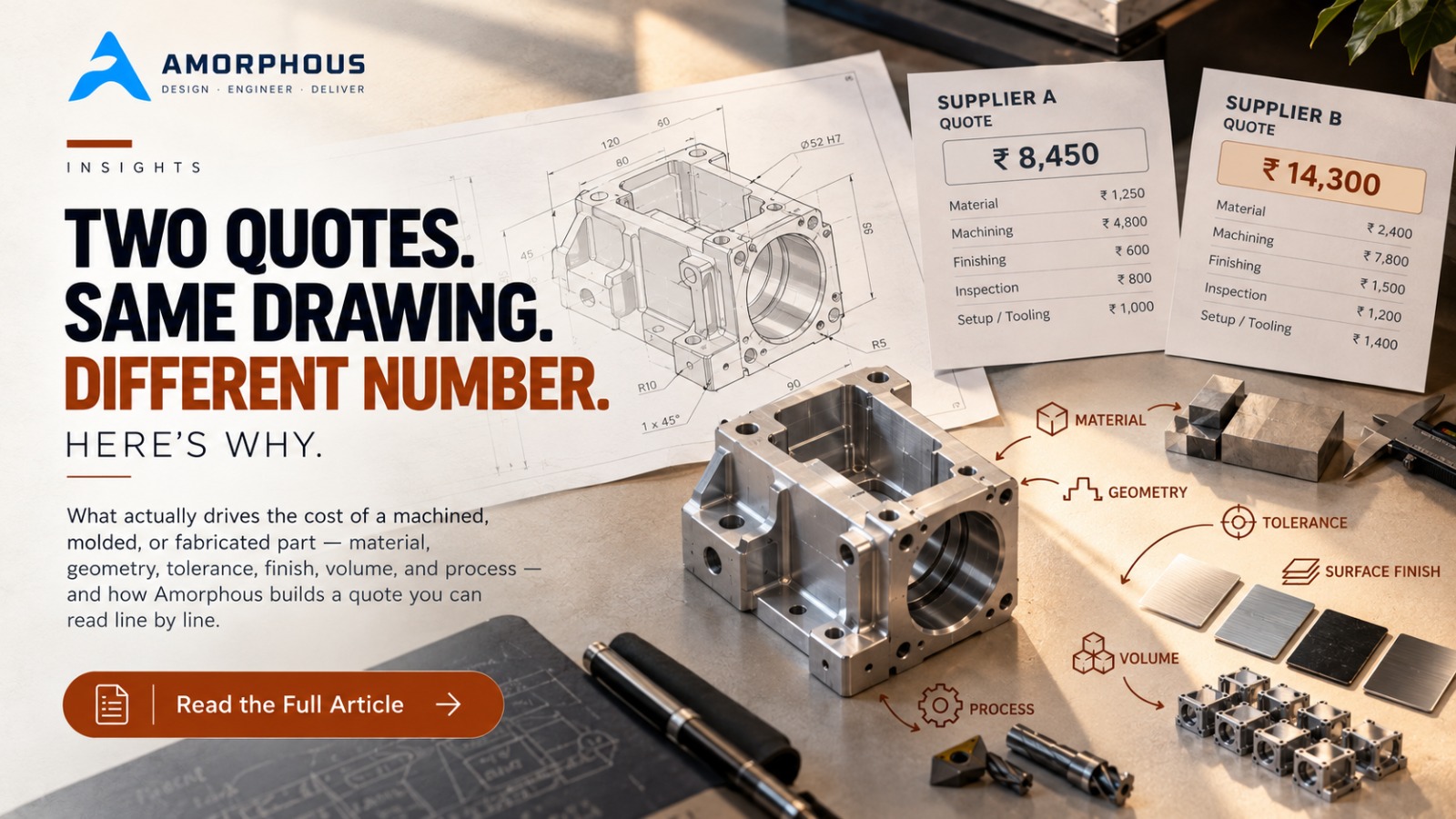
TWO QUOTES. SAME DRAWING. DIFFERENT NUMBER. HERE’S WHY.
What actually drives the cost of a machined, molded, or fabricated part — material, geometry, tolerance, finish, volume, and process — and how Amorphous builds a quote you can read line by line.
1. The Quote That Doesn’t Add Up
You send the same drawing to three suppliers and get three prices that don’t resemble each other. Nobody is necessarily lying. Each shop is pricing a different set of assumptions about material, tolerance, volume, and finish — assumptions the drawing rarely states out loud. Amorphous quotes parts for clients across several countries, and the first thing we do is make those assumptions visible.
Cost isn’t a mystery, and it isn’t a single number. It’s the sum of a handful of drivers that behave very differently from one another. Amorphous treats every quote as an answer to six questions, and once you know them, you can read any supplier’s price, ours included, with a lot more confidence.
2. How Amorphous Builds a Quote
Every quote at Amorphous is built from the same sequence, so a client can see where the money goes.
- Read the drawing and the intent — Amorphous works out what the part actually has to do, then looks at which features drive that function and which are simply inherited from a template.
- Choose the process before the price — Amorphous picks the manufacturing route that fits the geometry and volume, because the process sets the shape of the whole cost curve.
- Price time and material separately — Amorphous splits raw material, machine and setup time, finishing, and inspection into distinct lines, so any one of them can be questioned.
- Flag the cost drivers back to the client — Amorphous marks the specific features, tolerances, or finishes that are pushing the price up, with the option to relax them where function allows, ideally during Design rather than after.
3. The Six Drivers of Part Cost
Amorphous sees the same six drivers behind almost every quote, whether the part is a bracket, a housing, or a medical fitting.
Material
Material cost has two parts: the price per kilogram, and how much of the stock ends up as chips. Amorphous accounts for both, and for machinability, since a hard alloy costs more in tool wear and cycle time than it does on the invoice. The Material Guide is where we compare options before a spec gets locked.
Geometry and complexity
Every extra setup, deep pocket, thin wall, or hard-to-reach feature adds machine time and risk. Amorphous looks hardest at features that force a part to be re-fixtured or need special tooling, because those cost far more than their size suggests in CNC and VMC machining.
Tolerance
Tolerance is the driver clients most often over-specify. Tightening it rarely adds cost in a straight line: it pushes a feature toward slower cutting, extra finishing passes, and more demanding inspection. Amorphous reserves tight limits for the features that need them and applies GD&T so the tolerance sits where function actually depends on it, not on every dimension.
Surface finish and secondary operations
A finished surface, a coating, or a heat treatment each adds a process step, often at a different vendor or station. Amorphous lists these separately, since a requirement written casually on a drawing can quietly become one of the larger lines in the quote.
Volume
Volume decides how setup and tooling costs get spread. For machined parts, programming and fixturing are paid once and amortized over the run. For molded parts, the tool is the big upfront cost and the per-part price falls as quantity rises. Amorphous shows a client both the unit price and the fixed cost behind it, so the break-even between processes is visible instead of assumed.
Inspection, documentation, and lead time
Inspection time, certificates, and traceability paperwork are real cost, and so is a compressed schedule. Amorphous prices them as their own lines, and for international orders it adds packaging, freight terms, and export documentation to the picture, so the landed cost is clear and not just the ex-works price.
4. How the Process Choice Reshapes the Cost Curve
The same part can sit on very different cost curves depending on how it’s made. Amorphous chooses among processes by asking where each one is cheapest, which is rarely where intuition says.
- Prototype quantities: Amorphous reaches for 3D printing or machining, where there’s no tooling to pay for before the first part.
- Small batches in production-like material: Urethane and vacuum casting let Amorphous deliver real parts without a steel mold.
- Flat, formed parts: Laser cutting and sheet metal bending are usually the economical route for Amorphous when the geometry is essentially 2D.
- High volume: Amorphous moves to injection molding once the quantity justifies the tool and the per-part price falls.
5. Where This Shows Up Across Industries
Amorphous sees the weighting of these drivers change by sector — browse the Projects gallery for how it plays out in practice.
- UAV: Weight and material choice dominate, so Amorphous weighs material cost against performance using the UAV Materials & Processes Guide.
- Medical: Inspection and documentation carry real weight in the price, in line with the Medical Guide.
- Automotive: Repeatability across a run matters most, so Amorphous prices the process capability along with the part, referencing the Process Guide.
- Consumer: Volume and finish usually drive the number, and Amorphous models the tooling break-even early, before the design is frozen.
6. Practical Ways to Lower a Quote Without Lowering the Part
Most savings come from decisions made before a quote is requested. Amorphous suggests four, each of which is easiest to act on during Digital Prototyping, while the design is still cheap to change.
- Relax tolerances that don’t carry function. Amorphous will mark which ones are safe to loosen.
- Standardize hole sizes and corner radii. Amorphous finds this reduces tool changes and setup complexity.
- Choose a machinable material when the performance gap is small. Amorphous compares options against the actual load case.
- Say the real quantity. Amorphous prices a one-off and a recurring run very differently, and a vague quantity forces a vague quote.
7. Questions We Get From Clients
Why is the first part so much more expensive than the hundredth?
Setup, programming, and fixturing are paid once, so a small run carries them on few parts. Amorphous shows the fixed and per-part costs separately so this is easy to see.
Is the cheapest quote the best value?
Not automatically. A low price can reflect looser assumptions about tolerance, inspection, or material. Amorphous suggests comparing quotes line by line, not just on the total.
When does injection molding become cheaper than machining?
When quantity is high enough to recover the cost of the tool. The exact point depends on part size, complexity, and material, so Amorphous works it out per project instead of quoting a universal number.
Can I get a price range before the design is final?
Yes. Amorphous can give a range from a concept or early model, and tighten it as the design firms up, as part of our full Services engagement.
A good quote is one you can argue with.
Amorphous shows its working on every line, so you can see exactly what you’re paying for, and decide what’s worth keeping.
Send Amorphous your drawing — amorphousindia.com/contact