
- September 11, 2026
- 0 Comments
WE START WITH A BLOCK. WE REMOVE UNTIL IT’S THE PART.
A working guide to subtractive manufacturing — the family of processes behind “CNC,” how Amorphous picks between them, and when cutting away material still beats every other option.
1. “CNC” Is Not One Process
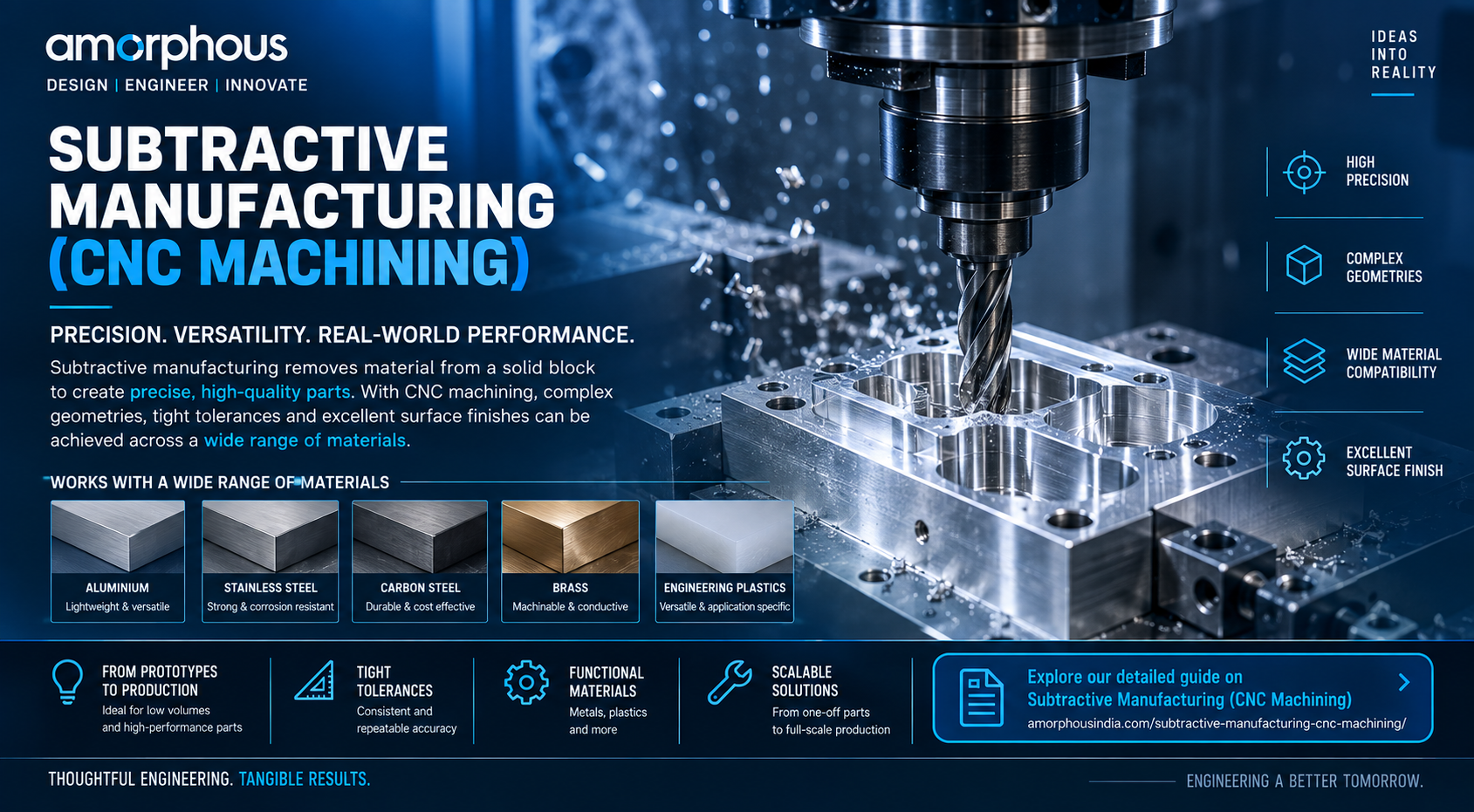
“CNC” gets used as shorthand for the whole family, but subtractive manufacturing actually covers several distinct processes — milling, turning, drilling, grinding, EDM — each removing material a different way, for a different reason. Amorphous picks among them based on the part’s geometry, not a single default machine.
What ties the family together isn’t the machine, it’s the principle: start with more material than the part needs, and cut away everything that isn’t the part. Amorphous leans on that principle constantly because it produces something additive and forming processes often can’t match — tight tolerances, fine surface finish, and predictable mechanical properties straight from solid stock.
2. How Amorphous Chooses Among Subtractive Processes
Every part that lands on Amorphous‘s subtractive floor goes through the same short set of questions before a machine gets chosen.
- Read the geometry — Amorphous checks whether the part is fundamentally rotational (a shaft, a bushing) or prismatic (a bracket, a housing) inside Design, since that alone rules out half the process family immediately.
- Check the tolerance and finish callouts — Amorphous reads the GD&T on the drawing to see if standard milling or turning gets there, or if a feature needs grinding or EDM to actually hold.
- Confirm the material is machinable as specified — Amorphous checks hardness and material behaviour against the Material Guide, since a hardened tool steel changes the process choice before geometry even enters the conversation.
- Machine, inspect, and iterate — Amorphous cuts the part on CNC and VMC machining equipment, checks it against the drawing, and adjusts toolpaths before a full production run locks in.
3. The Subtractive Family, Beyond Milling and Turning
Amorphous reaches past the two most familiar processes whenever a part’s geometry, material, or tolerance actually demands it.
Milling
A rotating cutter removes material from a stationary workpiece. Amorphous uses this as the default for prismatic parts — brackets, housings, plates — where the geometry has flat faces, pockets, or holes in multiple orientations.
Turning
The workpiece spins against a stationary cutting tool. Amorphous reaches for this on rotationally symmetric parts — shafts, bushings, standoffs — where milling the same geometry would take far longer for no benefit.
Grinding
An abrasive wheel removes material in very fine increments. Amorphous uses grinding when a surface finish or dimensional tolerance is tighter than milling or turning can reliably hold on their own.
EDM (electrical discharge machining)
Removes material through electrical sparks rather than physical cutting force. Amorphous turns to EDM for hardened tool steels and geometries — sharp internal corners, deep narrow slots — that a rotating cutting tool physically can’t reach.
4. Subtractive vs. the Alternatives
Amorphous still defaults to subtractive manufacturing for a large share of parts, even with additive and forming processes available — the decision comes down to what the part actually needs.
- vs. 3D printing: Amorphous chooses subtractive over 3D printing whenever isotropic strength, tight tolerance, or a specific metal alloy matters more than geometric freedom.
- vs. sheet metal + laser cutting: Amorphous moves to CNC machining instead of laser cutting and bending the moment a part needs true 3D features a flat sheet can’t fold into.
- vs. injection molding: Amorphous stays with subtractive machining below the volume where injection molding tooling actually pays for itself.
5. Where This Shows Up in Real Projects
Amorphous applies GD&T across a wide industry spread — browse the Projects gallery — wherever fit and assembly matter as much as raw dimensional accuracy.
- Automotive — Bolt patterns & mounts: Amorphous applies position tolerances referenced against the Process Guide so brackets bolt up correctly across a full production run.
- Medical — Sealing enclosures: Amorphous specifies flatness on mating faces checked against the Medical Guide for housings that need a reliable seal.
- Legacy parts — Reverse-engineered assemblies: Amorphous pairs this with reverse engineering to assign proper GD&T to a part that never had a real drawing to begin with.
- Consumer — Injection-molded assemblies: Amorphous applies material condition modifiers on high-volume injection molded parts to reduce rejection rates without loosening fit.
5. Where This Shows Up in Real Projects
Amorphous runs subtractive manufacturing across a wide industry spread — browse the Projects gallery — usually wherever precision matters more than production speed.
- Automotive — Precision shafts & housings: Amorphous turns and mills components referenced against the Process Guide for repeatable fits across a production run.
- Medical — Surgical instrument components: Amorphous machines to tolerances checked against the Medical Guide, where grinding often finishes a critical surface.
- Consumer — Functional prototypes: Amorphous machines parts that need to test like the final production material, not just look like it, ahead of Digital Prototyping sign-off.
- UAV — Structural mounts: Amorphous machines lightweight, high-strength mounts where a printed or cast alternative can’t guarantee the same mechanical properties.
6. Why Subtractive Still Wins, Even With Additive Getting All the Attention
3D printing gets most of the headlines, but Amorphous still reaches for subtractive manufacturing on the majority of precision, load-bearing, and production-representative parts — because a part machined from solid stock has consistent, predictable material properties in every direction, something layer-built parts still can’t fully guarantee.
It’s also simply faster to trust at scale. Amorphous can hold the same tolerance on part 1 and part 100 of a subtractive run, which is exactly the repeatability a client needs once a design moves from prototype toward production.
7. Questions We Get From Clients
Is subtractive manufacturing the same thing as CNC machining?
CNC just refers to computer control of the machine. Amorphous treats subtractive manufacturing as the broader category — milling, turning, grinding, EDM — that CNC equipment carries out.
How much material waste does subtractive manufacturing produce?
More than additive processes, by definition — material is being removed, not added. Amorphous optimizes stock size and nesting to minimize waste without compromising the part.
Can subtractive manufacturing produce complex internal geometry?
Only to a point — deep, fully enclosed internal features are usually beyond what a cutting tool can reach. Amorphous flags this early and recommends an alternative process when a design needs it.
When should I move from subtractive to injection molding?
Once volume climbs high enough to justify tooling cost. Amorphous walks through that threshold as part of our full Services engagement, rather than defaulting to one process out of habit.
Have a part that needs to hold a real tolerance?
Amorphous runs subtractive manufacturing alongside design, simulation, and production — one team, one model, no handoffs.
Talk to Amorphous — amorphousindia.com/contact