
- September 11, 2026
- 0 Comments
THE DRAWING NOTE NOBODY READS UNTIL SOMETHING DOESN’T FIT.
A working guide to GD&T — what those small symbols on a drawing actually control, and why Amorphous applies them before a part ever reaches the shop floor.
1. The Tolerance Nobody Notices Until Assembly
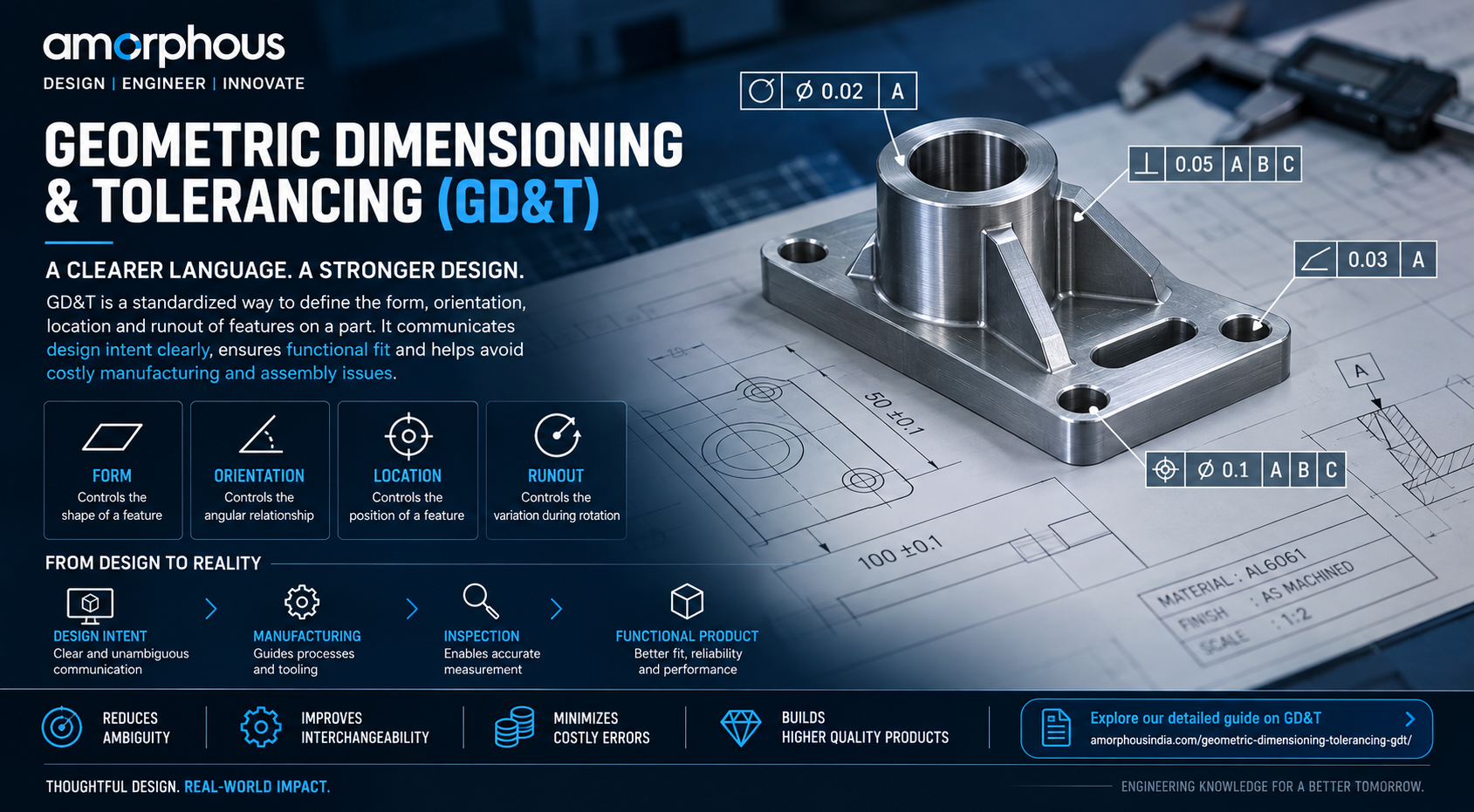
A plain ± tolerance on a dimension only controls size. It says nothing about whether a hole is actually where it needs to be relative to an edge, or whether a face is flat enough to seal against a gasket. Amorphous uses GD&T — Geometric Dimensioning and Tolerancing — to control exactly that: position, orientation, form, and how features relate to each other, not just how big they’re allowed to be.
The reason it matters shows up late, and expensively — at assembly, not at inspection. Amorphous has seen parts that pass every individual dimensional check still fail to assemble, because nothing on the drawing controlled how those dimensions related to each other. GD&T is what closes that gap.
2. How Amorphous Applies GD&T on a Drawing
Every drawing at Amorphous that needs more than a basic size tolerance goes through the same sequence.
- Establish the datums — Amorphous picks reference features — usually the ones the part actually locates from in assembly — since every other tolerance on the drawing measures from these.
- Identify which features actually need control — Amorphous applies GD&T only where it changes function — a mounting hole pattern or a sealing face, not every dimension on the part, since over-tolerancing drives up cost without adding value.
- Choose the right control and tolerance zone — Amorphous matches the callout — position, flatness, perpendicularity — to what the feature actually needs to do, inside Design, rather than defaulting to whichever symbol is most familiar.
- Verify it’s inspectable — Amorphous checks that every callout can actually be measured on the shop floor or with available tools — a tolerance nobody can verify isn’t a real tolerance, just a wish.
3. The Controls Worth Actually Knowing
Amorphous leans on a handful of GD&T controls far more than the rest — knowing these covers most of what shows up on a real drawing.
Datums
The reference frame everything else measures from. Amorphous picks datums that match how the part is actually held or located in assembly and in manufacturing — not just whichever surface is easiest to draw.
Position
Controls where a feature — usually a hole — actually sits, as a round tolerance zone instead of a boxy ± dimension. Amorphous uses this on bolt patterns and mounting holes, where a boxy tolerance zone would either reject good parts or pass bad ones.
Flatness and perpendicularity
Form and orientation controls that a size dimension can’t touch at all. Amorphous specifies these on sealing faces and mating surfaces, where a part can be exactly the right thickness and still leak if the face isn’t flat.
Material condition modifiers (MMC/LMC)
Modifiers that let a tolerance loosen as a feature’s size moves away from its worst-case condition. Amorphous applies these on high-volume production parts, where they can meaningfully cut rejection rates without changing what actually assembles.
4. GD&T vs. Plain ± Tolerances: When Each Is Enough
Not every dimension needs GD&T, and adding it everywhere just slows down inspection without improving the part. Amorphous keeps plain ± tolerances for dimensions that stand alone — an overall length, a wall thickness — and reserves GD&T for features that interact with something else: mating parts, assembly fixtures, sealing surfaces.
The test Amorphous applies is simple: if a feature’s relationship to another feature matters more than its size alone, it needs GD&T. This shows up constantly in CNC and VMC machining and sheet metal bending work, where bolt patterns and mating flanges are exactly the features a size tolerance alone can’t adequately control.
5. Where This Shows Up in Real Projects
Amorphous applies GD&T across a wide industry spread — browse the Projects gallery — wherever fit and assembly matter as much as raw dimensional accuracy.
- Automotive — Bolt patterns & mounts: Amorphous applies position tolerances referenced against the Process Guide so brackets bolt up correctly across a full production run.
- Medical — Sealing enclosures: Amorphous specifies flatness on mating faces checked against the Medical Guide for housings that need a reliable seal.
- Legacy parts — Reverse-engineered assemblies: Amorphous pairs this with reverse engineering to assign proper GD&T to a part that never had a real drawing to begin with.
- Consumer — Injection-molded assemblies: Amorphous applies material condition modifiers on high-volume injection molded parts to reduce rejection rates without loosening fit.
6. Why Getting This Right Saves Real Money
A missing or vague tolerance doesn’t fail in the design review — it fails on the assembly line, or worse, in the field, when a batch of parts that individually pass inspection collectively won’t bolt together. Amorphous treats GD&T as cheap insurance against that outcome, verified early through Simulation and design review rather than discovered at a production run’s expense.
It also protects margin on the manufacturing side. Amorphous uses correctly applied GD&T — especially material condition modifiers — to avoid rejecting parts that are functionally fine but would fail an overly rigid ± tolerance, which matters directly on cost-sensitive production runs.
7. Questions We Get From Clients
Does every part need GD&T?
No — Amorphous reserves it for features where fit or assembly actually depends on it, and uses plain tolerances everywhere else to keep drawings simple and inspection fast.
Can GD&T be added to an existing drawing later?
Yes, though it’s cheaper to get it right the first time. Amorphous can retrofit GD&T onto legacy drawings, often as part of a reverse engineering project.
Do all machine shops read GD&T the same way?
It’s a standardized language, but interpretation quality varies. Amorphous applies GD&T per the standard specifically so a drawing means the same thing to any shop that reads it.
How do I know if my current drawings have a tolerancing problem?
A common sign is parts that individually pass inspection but won’t assemble. Amorphous reviews drawings for exactly this gap as part of our full Services engagement.
Tired of parts that pass inspection but won’t assemble?
Amorphous applies GD&T alongside design, simulation, and production — one team, one model, no handoffs.
Talk to Amorphous — amorphousindia.com/contact