
- August 31, 2026
- 0 Comments
SAME SILICONE MOLD. DIFFERENT JOB TO DO.
Urethane casting vs. vacuum casting — how Amorphous produces 10 to 100 production-grade parts without ever cutting a steel mold, and which one actually fits your part.
1. Same Family, Different Job
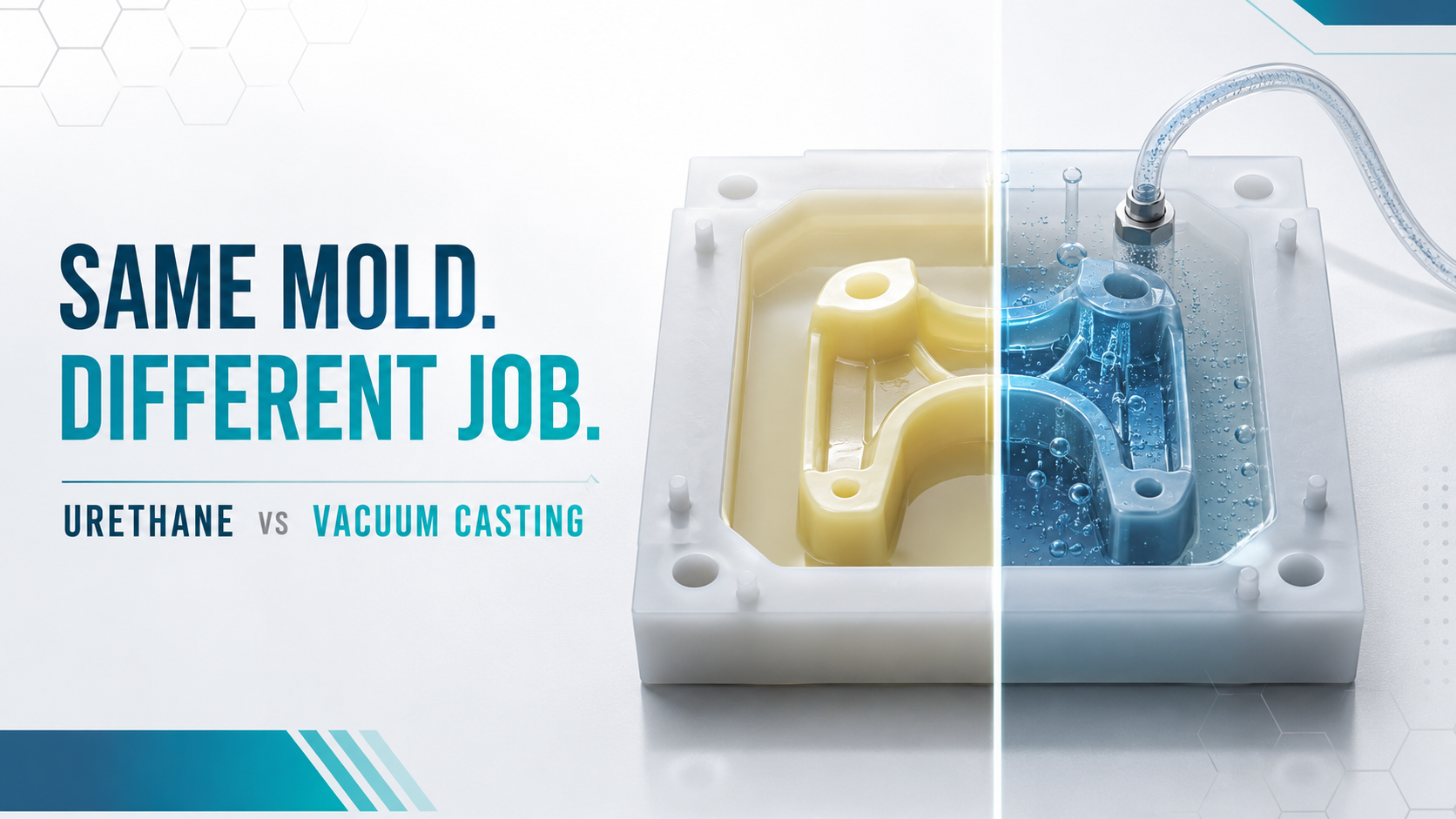
Urethane casting and vacuum casting get used almost interchangeably, and honestly, they overlap more than they don’t — both pour two-part polyurethane resin into a silicone mold instead of a machined steel one. Amorphous runs urethane casting and vacuum casting as two angles on the same family of process, not two unrelated services.
The real difference is what each is optimized to prove. Amorphous leans on urethane casting when a part needs to perform and feel like the end material — rubber-like flexibility, optical clarity, production-grade strength. Vacuum casting gets the call when the part’s geometry is the hard part — thin walls, overhangs, threads, and internal features that need to fill completely without trapping a single air bubble.
2. How Amorphous Runs Either Process
Both processes at Amorphous follow the same backbone — only the casting step itself changes.
- Build the master pattern — Amorphous produces a high-resolution master, usually through 3D printing, finished smooth enough that every surface flaw doesn’t end up copied into every part that follows.
- Cast the silicone mold — Amorphous encapsulates the master in silicone, then cuts the cured block along a parting line and removes the pattern, leaving a cavity that can reproduce the part dozens of times over.
- Pour and cure the resin — here the two paths split. Amorphous pours under vacuum when the geometry demands total, bubble-free fill; otherwise the resin cures under standard pressure, chosen for material match rather than geometric difficulty.
- Demold, trim, and repeat — Amorphous demolds and finishes each part, then reuses the same silicone tool for the next unit — typically good for 15 to 25 castings before quality starts to drift.
3. Where Each One Actually Wins
Amorphous picks between them based on what the part has to prove first — material behavior, or geometric precision.
Urethane casting: when the material has to feel right
Urethane resins can mimic ABS, PP, rubber, or optical-grade clarity — closer to a real production material than any 3D print. Amorphous reaches for urethane casting on dashboards, seals, gaskets, and enclosures where a client needs to test how the part actually feels and performs, not just how it looks.
Vacuum casting: when the geometry is the hard part
Thin walls, threads, overhangs, and internal features all rely on the resin reaching every corner of the mold before it cures. Amorphous uses vacuum casting specifically to pull resin into those hard-to-reach details with high repeatability, on parts like connector housings where a missed corner means a rejected part.
In practice, most jobs use both
A part with fine detail and a demanding material spec doesn’t force a choice. Amorphous often pours under vacuum with a urethane resin selected for its end-use properties — the two aren’t competing options so much as dials on the same process.
4. Casting vs. the Alternatives
Amorphous places casting between two more familiar processes, and picks based on volume and how close the part needs to be to final production intent.
- vs. 3D printing: Amorphous still starts with 3D printing for the master pattern, but casting delivers a production-representative material a printer can’t — real polyurethane instead of a printed polymer.
- vs. injection molding: Amorphous holds off on plastic injection molding until volume actually justifies a steel tool — silicone-mold casting covers the 10-to-100-unit range at a fraction of the tooling cost.
5. Where This Shows Up in Real Projects
Amorphous runs low-volume casting across a wide industry spread — browse the Projects gallery — usually wherever a client needs real parts in hand before committing to tooling.
- Automotive — Dashboards & trim: Amorphous casts urethane parts that match production material feel, referenced against the Process Guide for pre-production sign-off.
- Medical — Connector housings: Amorphous vacuum-casts fine internal features checked against the Medical Guide for compliance-ready fit testing.
- Consumer — Enclosures & seals: Amorphous selects resin properties using the Material Guide to match rubber-like or rigid feel before committing to injection tooling.
- UAV — Overmolded grips & mounts: Amorphous casts small-batch overmolded parts where CNC and VMC machining can’t replicate a soft-touch or rubberized surface.
6. Why Cast Instead of Going Straight to Tooling
Committing to a steel mold before a design is fully validated is one of the most expensive mistakes in product development — a late change means recutting tooling, not editing a CAD file. Amorphous uses casting as the checkpoint between Digital Prototyping and mass production, where a client gets real, production-grade parts in hand to test before that decision is locked in.
It also buys time. Amorphous can turn a silicone mold around fast enough to support a product launch or a funding milestone that a multi-week steel tooling cycle simply can’t hit, all while the Design stays open to changes based on what the cast parts reveal.
7. Questions We Get From Clients
How many parts can one silicone mold actually produce?
Typically 15 to 25 castings before quality starts to drift, depending on part complexity. Amorphous can cut a fresh mold from the same master if a project needs more.
Can cast parts be colored or textured to match a final product?
Yes — Amorphous can pigment resin to match a target color and finish, and mold in surface texture directly from the master pattern.
Do I need to choose between urethane and vacuum casting up front?
Not really — Amorphous scopes the part first and usually combines both: a urethane resin chosen for material properties, poured under vacuum for geometric accuracy.
At what point should I move to injection molding instead?
Once volume climbs past roughly 100 units, or the project timeline supports tooling lead time. Amorphous walks clients through that threshold as part of our full Services engagement, rather than defaulting to one process by habit.
Need real parts in hand before you commit to a mold?
Amorphous runs urethane and vacuum casting alongside design, simulation, and production — one team, one model, no handoffs.
Talk to Amorphous — amorphousindia.com/contact