
- August 18, 2026
- 0 Comments
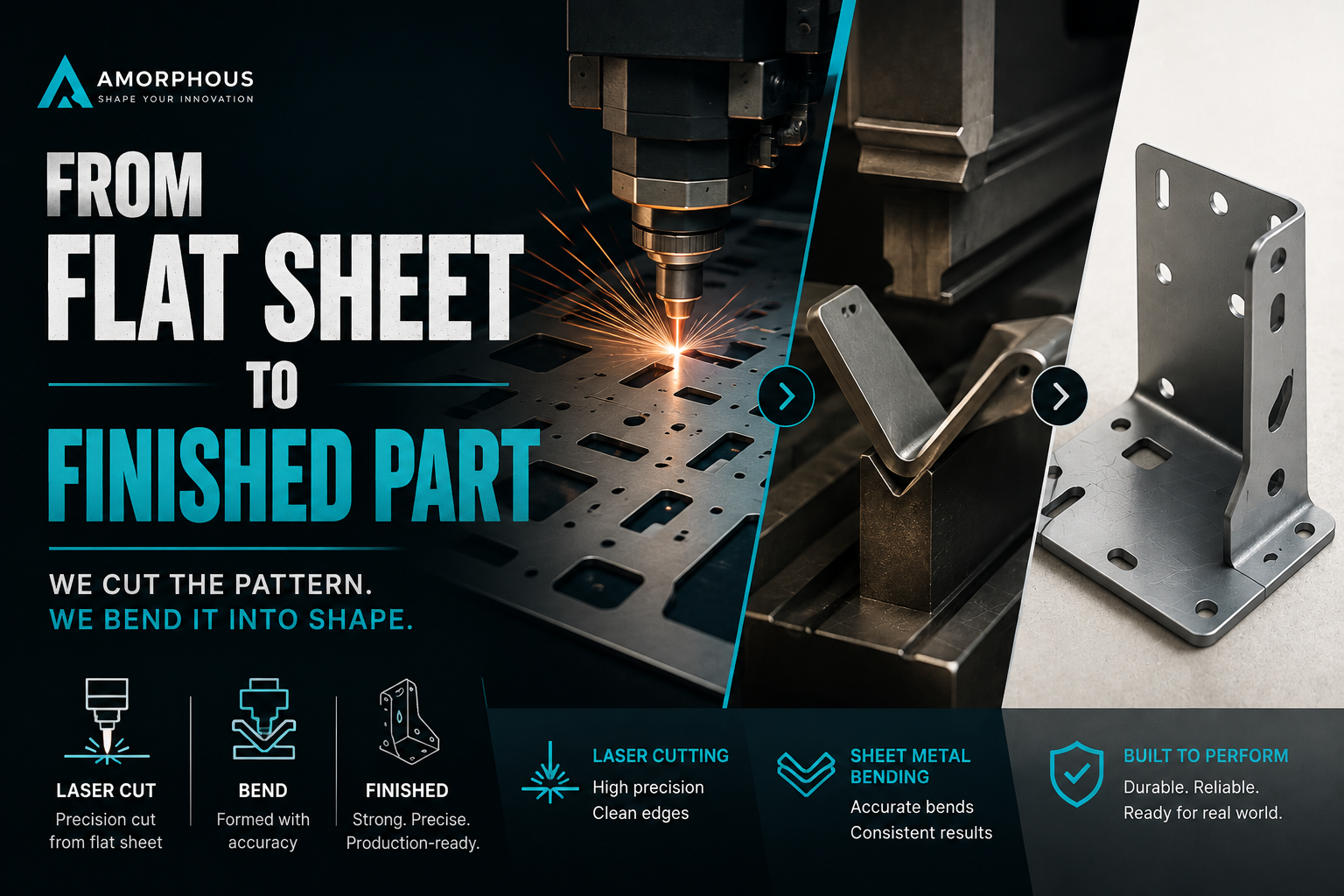
WE CUT THE PATTERN. WE BEND IT INTO SHAPE.
A working guide to laser cutting and sheet metal bending — how the two processes turn a flat sheet into a finished part, and when Amorphous reaches for CNC instead.
1. Two Processes, One Flat Sheet
Laser cutting and sheet metal bending are usually two steps in the same job, not two competing processes. Amorphous uses laser cutting to cut a flat pattern out of sheet stock, then sheet metal bending to fold that flat pattern into a real, load-bearing 3D part — an enclosure, a bracket, a chassis panel.
The reason both matter as their own topic is that most of the mistakes in a sheet metal part happen before it’s ever bent. Amorphous designs the flat pattern with bending already in mind — bend allowance, grain direction, minimum flange length — because a laser can cut a shape perfectly and it can still fail to fold correctly.
.
2. How Amorphous Takes a Sheet from Flat to Formed
Every sheet metal part at Amorphous moves through the same sequence, whether it’s a single bracket or a full enclosure with a dozen bends.
- Unfold the design into a flat pattern — Amorphous works this out inside Design, calculating bend allowance so the finished, formed part actually matches the intended dimensions — not the flat ones.
- Nest and laser-cut the sheet — Amorphous nests parts on the sheet to minimize scrap, then cuts through laser cutting, which holds tight tolerances on the flat profile before any forming happens.
- Bend it on the press brake — Amorphous forms the part in the correct bend sequence — later bends can make earlier ones unreachable if the order is wrong — respecting minimum flange length and grain direction at every fold.
- Weld, finish, and inspect — where a design calls for it, Amorphous joins formed pieces through TIG and MIG welding, then checks the final part against drawing before it ships.
3. Laser Cutting vs. CNC: Where Each One Wins
Amorphous picks between laser cutting and CNC machining based on what the part actually needs, not habit — the two overlap less than they seem to on paper.
Where laser cutting wins
Flat parts, thin-to-medium sheet, and high hole density. Amorphous reaches for laser cutting on brackets, panels, and enclosures where the geometry is essentially 2D — it’s faster and cheaper than machining the same profile out of solid stock.
Where CNC wins
Thick material, tight 3D tolerances, and features a laser physically can’t produce — internal pockets, threaded holes, precise stepped surfaces. Amorphous moves to CNC and VMC machining the moment a part needs true three-dimensional geometry instead of a cut-and-bend profile.
Where the line gets blurry
Thicker plate with only a few features can go either way. Amorphous weighs it against broader subtractive manufacturing options at that point — often it comes down to order volume and edge-finish requirements more than the geometry itself.
4. Sheet Metal Bending, in Four Terms Worth Knowing
Amorphous builds every bent part around the same handful of fundamentals — skip one and the part comes off the brake wrong, or doesn’t come off at all.
Bend allowance
Metal stretches slightly as it bends. Amorphous calculates this into the flat pattern up front so the formed part hits its actual intended dimensions, not the flat ones.
Minimum flange length
A flange too short can’t clear the bending die. Amorphous checks this during design so a part isn’t discovered to be unbendable only after it’s already been laser-cut.
Grain direction
Sheet metal is stronger bent across its grain than along it. Amorphous orients the nesting layout on the sheet to bend with the grain in mind, especially on tight-radius folds prone to cracking.
K-factor
A material- and thickness-specific constant that determines exactly how much a given sheet will stretch at a given bend radius. Amorphous keeps this dialled in per material so bend allowance calculations hold up across mild steel, stainless, and aluminium alike.
5. Where This Shows Up in Real Projects
Amorphous runs laser-cut and bent sheet metal across a wide industry spread — browse the Projects gallery — usually wherever a part needs to be light, stiff, and quick to produce in low-to-mid volume.
- Automotive — Chassis brackets & panels: Amorphous laser-cuts and bends mounting brackets referenced against the Process Guide for repeatable production runs.
- Medical — Equipment enclosures: Amorphous forms sheet metal housings checked against the Medical Guide for the finish and durability compliance demands.
- Consumer — Panels & brackets: Amorphous selects sheet gauge and finish using the Material Guide to balance stiffness against part weight and cost.
- UAV — Ground support & mounting hardware: Amorphous laser-cuts lightweight brackets and mounts, sized against loads confirmed separately through simulation before the sheet ever hits the brake.
6. When to Skip This Combination Entirely
Laser cutting and bending are fast and cheap for the right geometry, but they’re not the answer for everything. Amorphous moves to plastic injection moulding once volumes get high enough to justify tooling, and to CNC and VMC machining the moment a part needs true 3D geometry a flat sheet simply can’t fold into.
The decision usually comes down early, at the Design stage, before Amorphous commits a part to any single process. Getting it wrong here is the expensive mistake — not the cutting or bending itself, but choosing the wrong process for the part’s real volume and geometry needs, something a Digital Prototyping pass catches before production.
7. Questions We Get from Clients
Can any flat pattern be bent into any shape?
No — bend sequence, flange length, and tooling access all limit what’s actually possible. Amorphous checks bendability during design, not after the sheet is already cut.
Is laser cutting always cheaper than CNC?
For flat, 2D geometry, usually yes. Once a part needs true 3D features, Amorphous finds CNC ends up cheaper overall, since a laser-cut part would need secondary machining anyway.
How thick a sheet can actually be bent?
It depends on material and press brake tonnage available. Amorphous scopes this per project rather than quoting one blanket thickness limit.
Do bent parts need welding afterward?
Only if the design has separate pieces that need joining. Amorphous designs single-piece flat patterns to fold into a complete part wherever possible, spanning our full Services list, and reaches for welding only when the geometry genuinely requires it.
Have a part that starts flat and needs to hold its shape?
Amorphous runs laser cutting and sheet metal bending alongside design, simulation, and production — one team, one model, no handoffs.
Talk to Amorphous — amorphousindia.com/contact