
- August 9, 2026
- 0 Comments
THE PART ALREADY EXISTS. THE DRAWING DOESN’T.
A working guide to reverse engineering — how Amorphous turns a physical part with no CAD, no drawings, and no history into a model you can actually design from.
1. The Problem Reverse Engineering Actually Solves
Most engineering starts from a blank CAD file. Reverse engineering starts from the opposite place — a physical part that already works, with no drawing, no native CAD, and often no one left who remembers how it was designed. Amorphous runs reverse engineering to close that gap — a legacy automotive bracket, a discontinued medical fitting, a competitor’s part that needs benchmarking.
The goal isn’t just a pretty 3D model. Amorphous builds a model that’s actually usable downstream — dimensioned, toleranced, and ready to feed into simulation or a redesign. A scan that just looks like the part but can’t be edited or manufactured from has solved the wrong problem.
.
2. How Amorphous Reverse Engineers a Part
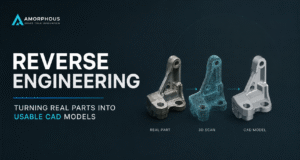
Every reverse engineering job at Amorphous follows the same arc — from physical object to usable CAD — even though the scanning method changes with the part.
- Digitize the part — Amorphous captures geometry with 3D scanning for external surfaces, or CT scanning when internal features — wall thickness, hidden cavities, lattice structures — matter as much as the outside.
- Clean the point cloud — raw scan data is noisy. Amorphous filters and aligns it into a usable mesh before any modeling starts, since a bad point cloud produces a bad model no matter how good the next step is.
- Rebuild it as real CAD — Amorphous converts the mesh into parametric surfaces and solids inside Design, not just a frozen scan — so the part can be edited, toleranced, and redesigned like any native model.
- Validate against the original — Amorphous checks the rebuilt model against the scan data for deviation, and applies GD&T so the part meets the fits and tolerances it actually needs, not just the ones it happened to have.
3. Not Every Reverse Engineering Job Is the Same
Amorphous scopes the approach to what the part actually needs to prove — exact replication and a redesign starting point call for different levels of detail.
Exact replication
The goal is a drop-in match — same fit, same function, no changes. Amorphous uses this for discontinued or out-of-production parts where the part itself is the spec, and the model just needs to reproduce it faithfully.
Redesign starting point
The scan is a foundation, not the finish line. Amorphous rebuilds the geometry cleanly enough to modify it — lightening a bracket, updating a fit, adapting a legacy part for 3D printing instead of the casting process it was originally designed for.
External 3D scanning
Fast and sufficient when only the outside surface matters. Amorphous uses this for housings, panels, and ergonomic surfaces where fit and appearance are the whole story.
CT scanning
Necessary when the inside of the part is part of the problem. Amorphous reaches for CT scanning on castings, molded parts, and assemblies where internal ribbing or wall thickness can’t be measured any other way without cutting the part apart.
4. Where This Shows Up in Real Projects
Amorphous reverse engineers parts across a wide industry spread — browse the Projects gallery — and the reason changes by industry even when the scanning process doesn’t.
- Automotive — Legacy parts: Amorphous rebuilds discontinued components into CAD, cross-referencing the Process Guide so the part can go back into production without the original tooling.
- Medical — Device fittings: Amorphous uses CT scanning to capture internal geometry precisely, checked against the Medical Guide for compliance-ready reproduction.
- Consumer — Competitor teardowns: Amorphous benchmarks a competing product’s geometry and materials, referencing the Material Guide to inform a client’s own design decisions.
- UAV — Damaged or worn parts: Amorphous reconstructs the original, undamaged geometry of a worn frame or mount, then hands it to Simulation to confirm it still meets load requirements
5. Why Reverse Engineer Instead of Redesigning From Scratch
Redesigning a working part from a blank sheet throws away everything that part already proved in the field — its fit, its durability, whatever quirks kept it running for years. Amorphous treats reverse engineering as the faster, lower-risk path when the part’s own history is worth more than a clean-slate guess, feeding the result straight into Digital Prototyping before anything is recut.
It also pairs naturally with in-depth research on materials and manufacturing methods that didn’t exist when the original part was made. Amorphous has used this combination to replace a die-cast legacy part with an injection-molded equivalent that’s lighter and cheaper to produce, without losing the fit the original part already had.
6. Questions We Get From Clients
Do you need the original part in hand, or can you work from photos?
The physical part, ideally. Amorphous can work from limited references in some cases, but scan accuracy — and everything built on top of it — depends on having the real object to digitize.
How accurate is a reverse-engineered model?
Accuracy depends on the scanning method and the part’s condition. Amorphous validates the rebuilt CAD against the original scan data and flags any deviation before it’s signed off.
Can a worn or damaged part still be reverse engineered?
Yes — Amorphous can reconstruct the original, undamaged geometry using engineering judgment and reference features on the part, rather than modeling the damage itself.
Is reverse engineering an existing product a legal gray area?
It depends on ownership and intent — reproducing your own legacy part is different from copying a competitor’s patented design. Amorphous scopes this with clients up front as part of our full Services engagement.
Have a part with no drawing left to work from?
Amorphous runs reverse engineering alongside design, simulation, and production — one team, one model, no handoffs.
Talk to Amorphous — amorphousindia.com/contact